Slaying the Rating Zombie: Why Your Biggest Problem Is a Single Number
Jan 7, 2026
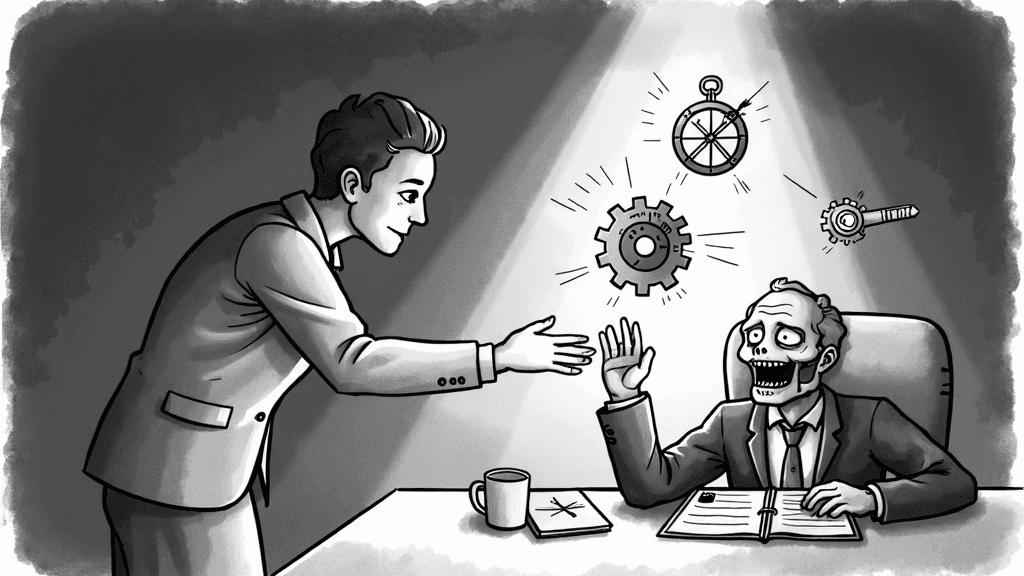
In the heart of every zombie appraisal lurks a single, toxic element: the rating. It is the brain of the undead process, reducing a year of complex, human effort into a crude number. This act of assigning a rating is the most destructive feature of the traditional performance review. It is the zombie’s bite, injecting a venom of comparison, anxiety, and demotivation into your organisation.
In our last article, we diagnosed the zombie apocalypse of the annual appraisal. Now, we target its most vital organ. Slaying the rating zombie is the single most important step you can take to reclaim your performance management process. It is the act of choosing conversation over calculation, development over judgment, and human nuance over bureaucratic simplicity.
The Illusion of Objectivity: Why Ratings Are a Lie
The appeal of the rating is its promise of fairness. This is a dangerous fantasy. Decades of research have proven that ratings are a deeply flawed and unreliable measure. They are less a reflection of the employee’s performance and more a reflection of the rater’s own biases. This is the “Idiosyncratic Rater Effect”: more than 60% of the variance in a rating is attributed to the rater, not the employee.
Your rating is not a measure of your work; it is a measure of your manager’s perception, clouded by cognitive biases like:
The Recency Effect: Over-weighting recent events.
The Halo/Horns Effect: An initial positive or negative impression colours all subsequent judgments.
Confirmation Bias: Unconsciously seeking information that confirms an existing opinion.
To believe a manager can set these biases aside is to believe in fantasy. The rating is not a scientific measurement; it is a number wrapped in a story written by the rater.
The Psychological Damage of Being a Number
Beyond their unreliability, ratings inflict profound psychological damage. The moment you reduce a person to a number, you trigger a primal threat response, threatening their needs for safety and esteem. The conversation is no longer about growth; it is about survival.
Herzberg’s two-factor theory provides a crucial insight here. A rating, at best, is a “hygiene factor.” A good rating doesn’t inspire greatness; it merely provides relief. A bad rating, however, is a powerful source of dissatisfaction that can cripple motivation. By focusing on this single number, we are polishing hygiene factors while starving our people of the true “motivator factors” like recognition and growth.
The Cure: The Developmental Conversation
Slaying the rating zombie means replacing a judgmental process with a developmental one. The cure is to shift from a conversation about a number to a conversation about growth. This is the Developmental Conversation, built on psychological safety and a commitment to helping people realise their potential.
It is guided by a new set of principles:
It Is Decoupled from Compensation: This is non-negotiable. The conversation is purely about growth. Pay decisions are made separately.
It Is Forward-Looking: The focus is the future. The guiding questions are “Where do you want to go?” and “How can I help you get there?”
It Is Co-Created: The employee is an active participant, bringing their own topics and aspirations to the table.
It Is Strengths-Based: The conversation begins from a foundation of strength, seeking to build on what is working, not just fix what is broken.
It Is Continuous: It is part of an ongoing rhythm of feedback and coaching, not a once-a-year event.
Slaying the rating zombie requires courage, but the payoff is immense: a culture of trust, a more engaged workforce, and a sustainable competitive advantage.
Reflection Questions
For the Executive:
What are the real, tangible benefits we believe we are getting from our current rating system?
How much of our senior leadership’s time is spent on “calibration meetings,” trying to force-fit people into a distribution curve?
If our ratings are mostly a reflection of the rater, what are the implications for our pay-for-performance philosophy?
What message would it send to our organisation if we were to eliminate performance ratings?
How can we equip our managers with the skills to have meaningful developmental conversations without the crutch of a rating?
How do we create a system for making fair compensation decisions without a simple, but flawed, performance rating?
For the Manager:
When I am assigning a rating, do I feel that I am capturing the full picture of my team member’s contribution?
How would the quality of my conversations change if I did not have to deliver a rating at the end?
What is one developmental conversation I could have with a team member this month that is completely separate from any discussion of rating or pay?
How can I shift my own mindset from “rater” to “coach”?
How can I co-create the agenda for my next 1-on-1 with a team member to ensure it is focused on their growth?
What is one strength I see in a team member that is currently being underutilised?
For the Team Member:
How has the anticipation of receiving a rating affected my behaviour at work?
What is the most valuable developmental feedback I have ever received? Was it connected to a formal performance rating?
If I were to have a conversation with my manager that was purely focused on my growth, what are the top three things I would want to discuss?
What is a strength I have that I wish my manager would recognise and help me to develop further?
How can I proactively ask my manager for a forward-looking, developmental conversation?
What does “accountability” mean to me, and how could I demonstrate it without being assigned a number?