The Psychological Fortress: Building a Culture That Is Immune to the Zombie Virus
Jan 20, 2026
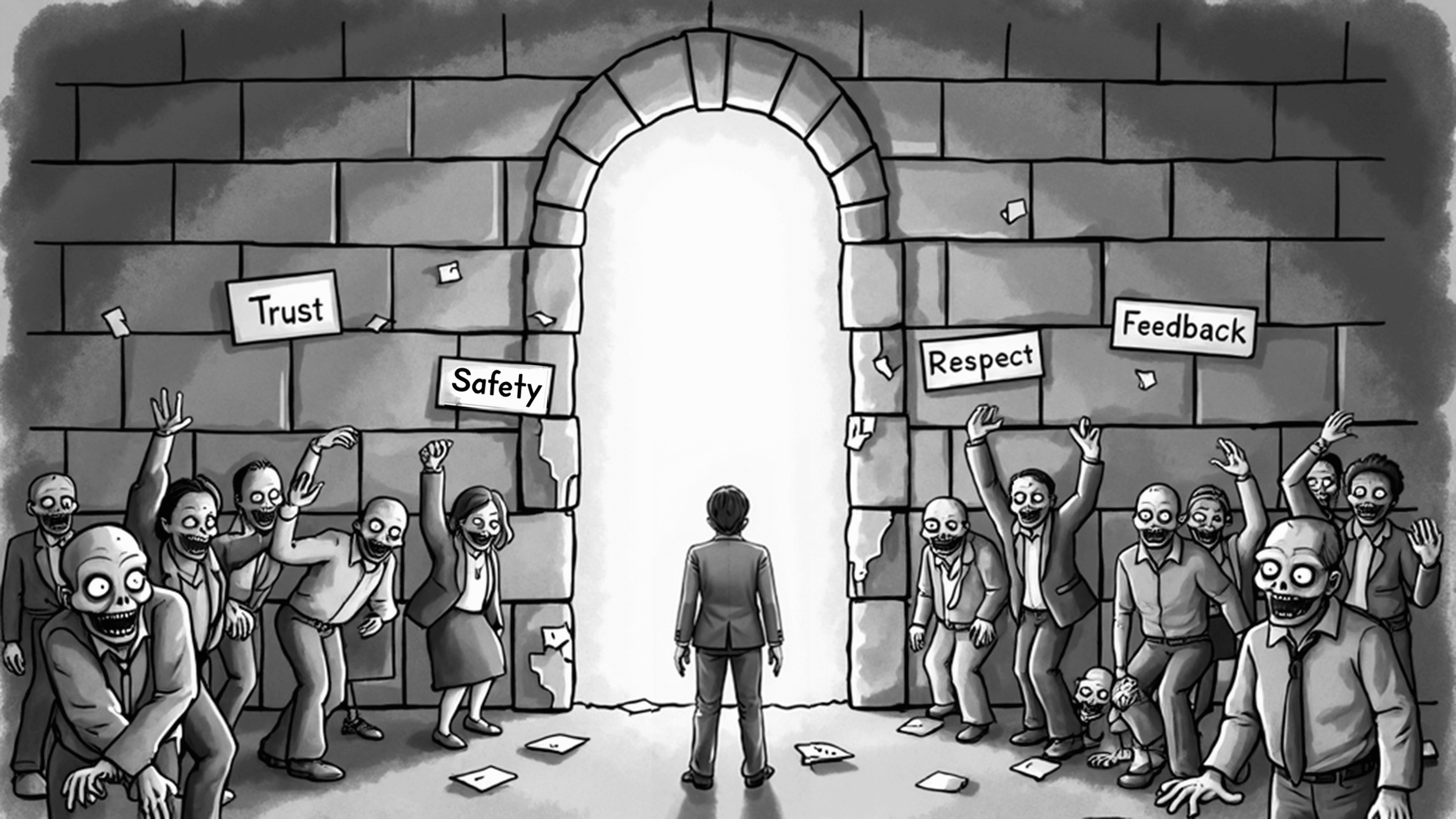
We have diagnosed the zombie appraisal, slayed the rating, and discovered the intrinsic cure of autonomy, mastery, and purpose. But an antidote is useless if the patient’s immune system is too weak to accept it. In an organisation, the immune system is the culture. If your culture is toxic, rife with fear and low on trust, even the most brilliant performance development system will be rejected. The zombie virus will find a way back in.
To survive the apocalypse long-term, we cannot just fight zombies; we must build a fortress, a sanctuary where the undead cannot thrive. That fortress is a culture of high psychological safety.
Psychological safety is the shared belief that a team is safe for interpersonal risk-taking. It is the soil in which the seeds of autonomy, mastery, and purpose can grow. This article is the architectural blueprint for that fortress, drawing on the pioneering work of Amy Edmondson to build a culture of psychological safety and continuous feedback.
The Enemy Within: How Fear Creates a Zombie Culture
A culture of fear is the perfect breeding ground for zombies. In a low-safety environment, employees learn that mistakes are punished, questions are a sign of weakness, and challenging the status quo is a career-limiting move. This creates its own legion of zombies: employees who are physically present but mentally and emotionally checked out.
The phrase “People don’t leave organizations; they leave bad managers” is a testament to this reality [1]. The zombie appraisal, with its focus on judgment, is often the primary weapon of these managers. To build our fortress, we must systematically dismantle this culture of fear. Research by Google’s Project Aristotle found that psychological safety was, by far, the most important factor in building a successful team.
The Blueprint for the Fortress: The Four Pillars of Psychological Safety
Building a culture of psychological safety is a leadership discipline built on four key pillars:
Frame the Work as a Learning Problem: Leaders must set the stage by being humble and admitting their own fallibility. Frame work not as tasks to be executed perfectly, but as experiments to be learned from.
Model Curiosity and Ask Lots of Questions: Leaders in a psychologically safe environment have all the questions, not all the answers. They are genuinely curious and signal that all voices are valued.
Acknowledge Your Own Fallibility: The most powerful thing a leader can say to build safety is, “I made a mistake.” This normalises failure and reframes it as a natural part of the learning process.
Respond Productively to Failure and Dissent: How a leader responds to bad news is the ultimate test. A productive response involves expressing appreciation (“Thank you for bringing this to my attention”), looking forward (“How can we fix this?”), and de-stigmatising the failure.
The Watchtowers of the Fortress: A System of Continuous Feedback
Psychological safety is the foundation, but a fortress also needs watchtowers. That system is continuous feedback. In a culture of high psychological safety, feedback is not a dreaded, once-a-year event; it is a constant, multi-directional flow of information. It is seen not as criticism, but as care.
To build this system, we need to:
Make It Frequent and Informal: The most effective feedback is often the small, in-the-moment course corrections and words of encouragement.
Separate Feedback from Evaluation: A continuous feedback culture is a coaching culture, not a judging culture.
Focus on Behaviour and Impact: Effective feedback is specific and actionable, avoiding labels and judgments about personality.
Promote Peer-to-Peer Feedback: Feedback should not be just a top-down phenomenon. Peer recognition and coaching are powerful tools for building shared ownership.
A culture of psychological safety, reinforced by continuous feedback, is a fortress immune to the zombie virus. It is an environment where people feel safe to be their authentic selves, to take risks, to learn, and to grow.
Reflection Questions
For the Executive:
How do we currently measure the level of psychological safety in our organisation?
When a major project fails, what is our organisation’s default response: a blameless post-mortem or finding someone to hold accountable?
How are our senior leaders actively modelling vulnerability and a learning mindset?
What are the systemic barriers that prevent employees from speaking up in our company?
How can we redesign our leadership training to focus on building psychological safety?
What is one organisational ritual we could introduce to make giving and receiving feedback a more normal and positive experience?
For the Manager:
On a scale of 1-10, how psychologically safe is my team? How would I know?
In my next team meeting, what is one question I can ask to signal my curiosity about my team’s diverse perspectives?
When was the last time I admitted a mistake to my team? What was the impact?
How do I typically react when a team member brings me bad news?
What is one thing I can do this week to make it safer for my team to take interpersonal risks?
How can I facilitate a peer feedback session on my team that is constructive and developmental?
For the Team Member:
Do I feel safe to voice a dissenting opinion in a team meeting? Why or why not?
What is one thing my manager does that helps me to feel psychologically safe?
What is one thing that would make me feel safer to take risks or admit mistakes?
How can I practice giving feedback to a peer in a way that is specific, actionable, and focused on behaviour?
When I receive feedback, is my initial reaction to be defensive, or am I able to listen for the learning?
What is one small step I can take to contribute to a more psychologically safe environment on my team?